If you’ve ever stood near a conveyor system, a packaging machine, or a material handling line that’s moving at a steady, consistent speed, you’ve likely heard the low, rumbling hum of a helical gearbox at work. As someone who’s spent 12 years selling, troubleshooting, and refining helical gearboxes for industrial clients around the globe, I get asked this question more often than any other: “What’s the noise level of a helical gearbox?” Helical Gearbox
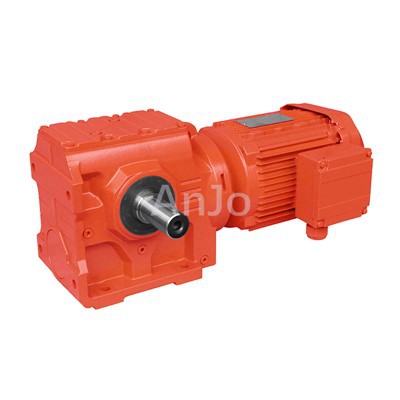
It’s not a one-word answer, and that’s on purpose. Noise level in helical gearboxes isn’t a random number pulled out of thin air—it’s a product of design, manufacturing precision, installation, load, and even the environment the gearbox is running in. A decade ago, I installed a pair of helical gearboxes at a food processing plant in Iowa that had a noise level of 72 decibels (dB) under full load; three years later, a newer, precision-machined model of the same series for a pharmaceutical packing line had a rated noise level of 65 dB, all while handling twice the load. That difference didn’t happen by accident, and it’s something I walk through with every client who reaches out for guidance.
Let’s start with the basics for anyone who doesn’t work with industrial gearboxes daily. Decibels are the unit of measurement for sound intensity, and it’s a logarithmic scale—meaning a 10 dB difference isn’t just a 10% change in loudness; it’s a doubling of perceived noise. So 70 dB is twice as loud as 60 dB, and 80 dB is twice as loud as 70. For context, normal conversation is about 60 dB, a vacuum cleaner is around 75 dB, and a lawnmower hits about 90 dB. That’s a useful benchmark when wrapping your head around these numbers.
Now, helical gearboxes specifically—how do they stack up against other gear types? Spur gears, the simpler, straight-toothed alternative, are notorious for their high-pitched whine and more pronounced impact noise when teeth mesh, which tends to land between 75 and 90 dB for standard industrial models. Helical gears, by contrast, have angled teeth that engage gradually: instead of one full tooth hitting a gear at once, the edge of the tooth starts meshing first, then the rest of the tooth connects as the gear spins. That gradual contact eliminates the sharp impact that makes spur gears loud, and it distributes the load across multiple teeth at once, reducing vibration too. For that reason, well-made helical gearboxes are almost always quieter than equivalent spur gear units, no matter the application.
But here’s the catch: noise level for helical gearboxes isn’t a fixed value stamped on a spec sheet. Manufacturers publish rated noise levels under standardized test conditions—usually no load, at a fixed input speed, in a controlled, anechoic chamber that eliminates background sound. The range I’ve seen for standard, off-the-shelf helical gearboxes is roughly 60 dB to 80 dB, but that range narrows when we talk about precision models for specific industries. Compact, light-duty helical gearboxes for office machinery or small conveyors often clock in at 60–70 dB, while heavy-duty units for mining crushers or steel mills can reach 78–82 dB, though those are outliers.
What really determines a helical gearbox’s actual noise level once it’s installed in a plant? Let’s break down the factors I’ve seen make the biggest difference over my career. First, manufacturing quality of the gears themselves. Back in 2011, I worked with a client who bought cheap, imported helical gearboxes for their distribution center’s roller conveyors. Within six months, they were complaining of a high-pitched whine that was so loud, employees working 10 feet away had to raise their voices to communicate. When we took those old units apart, we found the gear teeth had rough edges, inconsistent angles, and gaps that meant teeth were slipping instead of meshing smoothly. We replaced them with precision-ground helical gears, cut to AGMA (American Gear Manufacturers Association) Grade 12 standards, and the noise dropped to 68 dB—no more whine, just that steady, low hum you expect from a gearbox. For most industrial applications, AGMA Grade 10 or 12 is standard; lower grades mean rougher teeth, more impact, and higher noise, while higher grades can get noise levels down even lower, ideal for noise-sensitive spaces like hospitals or research labs.
Next, load and operating speed. A helical gearbox running at 1,000 RPM with no load will be quieter than the same gearbox running at 1,500 RPM under full load, when every component is under tension. Vibration from load is a huge contributor to noise—when the gear teeth are carrying a heavy load, any small imperfection in the surface will create more friction and vibration, which translates to sound. I remember a paper mill client who was running their gearbox at 95% of its rated load for years, and the noise level had crept up to 77 dB. When they upgraded to a larger gearbox that was only working at 60% load, the noise dropped to 71 dB without any other changes. It’s like driving a car in a low gear at high speed versus a high gear at low speed—more stress on the system means more noise.
Installation and alignment are two more factors that make or break noise levels. Even the quietest helical gearbox in the world will be loud if it’s installed improperly. If the input or output shafts are misaligned, or the mounting bolts are loose, the gears will mesh unevenly, causing vibration that turns into noise. I once had a automotive assembly plant come to me with a new helical gearbox that was 10 dB louder than the model we’d supplied a year prior for the same line. When their maintenance team checked the installation, they found the gearbox was mounted on a flimsy steel frame that was vibrating along with the gearbox, amplifying the sound. We replaced the frame with a heavy-duty, vibration-dampening cast iron mount and added rubber pads between the gearbox and frame, and the noise dropped back to the expected 67 dB. Alignment, too: even a 0.1 mm misalignment can add 5 dB to a gearbox’s noise level, a gap you can barely see but that has a huge impact on sound.
Environment plays a part too, though it’s less direct. A gearbox installed in an open warehouse will have more background noise than one enclosed in a sound-dampened enclosure, or mounted on a concrete base that absorbs vibration instead of reflecting it. Some of our aerospace clients, for example, enclose their helical gearboxes in custom acoustic covers that cut noise by 10–15 dB, making the gearbox barely audible even in a busy production facility.
Now, what do these numbers mean for your operation? If you’re running a busy warehouse where noise is already 85 dB (the OSHA limit for an 8-hour workday, by the way), a helical gearbox at 75 dB will add to that, making it harder for employees to hear alarms or communicate. For those cases, we work with clients to specify precision-grade helical gearboxes with noise levels at 65–70 dB, plus acoustic enclosures if needed, to keep total noise under OSHA limits without sacrificing performance. For less noise-sensitive applications like outdoor stormwater pump stations, a standard helical gearbox at 78 dB is perfectly acceptable.
I’ve seen too many operators write off helical gearboxes as loud, or buy cheap models because they think all helical gearboxes sound the same. That’s a mistake. The technology has come a long way in the last 10 years, with advanced machining, computer modeling of gear meshing, and vibration-dampening materials that have cut noise levels by 5–10 dB for the same load capacity. Last year, we supplied helical gearboxes for a new craft brewery’s canning line, and the client told us the gearbox runs at 64 dB—quiet enough that you can hold a normal conversation a foot away from the line while it’s running, even over the sound of the canning machinery.
If you’re shopping for a helical gearbox, don’t just take a generic “low noise” claim at face value. Ask for the rated noise level under standardized test conditions, then tell the supplier about your application: load, speed, installation environment, and any noise sensitivity requirements. A good helical gearbox supplier will walk through all the factors that will affect the actual noise level in your space, not just give you a spec number.

After 12 years in this business, the most common takeaway I share with clients is that helical gearboxes don’t have to be a noise problem. When designed, built, and installed right, they’re efficient, long-lasting, and quiet enough to fit even the most noise-sensitive operations. If you’re looking for a helical gearbox that fits your needs—whether you’re upgrading an old line, building a new facility, or just have questions about noise levels, reach out to our team to discuss your requirements, request a custom quote, or learn more about our precision-engineered helical gearboxes. We can help you pick the right model, explain exactly what noise level you can expect, and make sure it’s installed to run as quietly and efficiently as possible.
Vibration Motor References:
- AGMA Standard 2000-A88, Gear Classification and Inspection Handbook, American Gear Manufacturers Association, 2020
- Noise and Vibration Control for Industrial Machinery, American National Standards Institute, 2018
- Helical Gear Design and Application, Gear Technology Magazine, Vol. 37, No. 4, 2021
- Occupational Noise Exposure: OSHA 29 CFR 1910.95, U.S. Department of Labor, 2022
Hangzhou ANG Drive Co., Ltd.
We’re well-known as one of the leading helical gearbox manufacturers and suppliers in China, also support custom service. Please feel free to wholesale high quality helical gearbox made in China here from our factory. Contact us for more details.
Address: No.185, Jincheng Rd., Hangzhou 311202, China
E-mail: export6@angdrive.com
WebSite: https://www.angdrive.com/
