Hey there! I’m a supplier of desiccant air dryers, and today I wanna chat about the regeneration process of these nifty machines. So, let’s dive right in! Desiccant Air Dryer
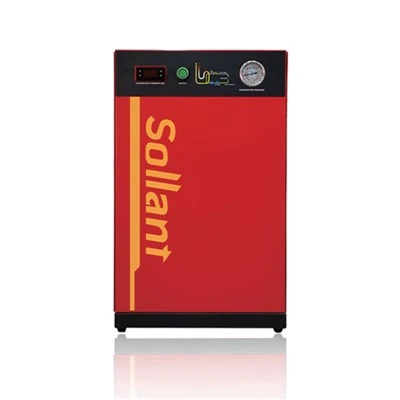
First off, what’s a desiccant air dryer? Well, it’s a crucial piece of equipment used in various industries to remove moisture from compressed air. Moisture in compressed air can cause all sorts of problems, like corrosion in pipes, damage to pneumatic tools, and even affect the quality of products in manufacturing processes. That’s where desiccant air dryers come in handy, by using desiccants to adsorb the water vapor and ensure the compressed air is dry.
Now, let’s get to the main topic: the regeneration process. In a desiccant air dryer, the desiccant bed eventually becomes saturated with moisture and loses its drying efficiency. That’s when the regeneration process kicks in to restore the desiccant’s drying capacity. There are generally two main types of regeneration methods: heatless regeneration and heated regeneration.
Heatless Regeneration
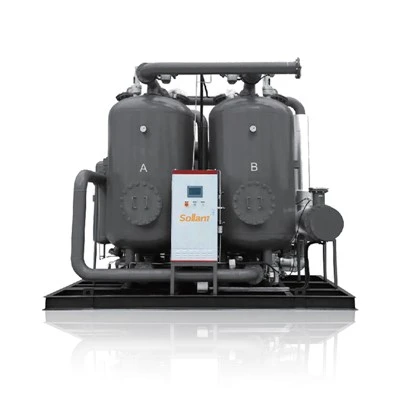
Heatless regeneration is a popular method, and it’s relatively straightforward. In a heatless desiccant air dryer, there are usually two desiccant beds. One bed is in the drying mode, while the other is in the regeneration mode.
When the desiccant in one bed gets saturated, the system switches the airflow. A small portion of the dry compressed air is diverted from the outlet of the drying bed. This dry air is then expanded to a lower pressure, which causes it to increase in volume. As it passes through the saturated desiccant bed, it picks up the moisture from the desiccant and carries it out of the dryer as waste.
The advantage of heatless regeneration is its simplicity. There’s no need for an external heat source, which makes the system more compact and easier to maintain. However, the downside is that it uses a significant amount of compressed air for regeneration. This can lead to higher energy costs, especially in large-scale applications.
Let me give you an example. Say you have a factory that uses a heatless desiccant air dryer. Every time the desiccant bed needs regeneration, a certain percentage of the dry compressed air is used up. Over time, this can add up to a substantial amount of wasted air, which means more energy is needed to produce the compressed air in the first place.
Heated Regeneration
Heated regeneration, on the other hand, uses an external heat source to remove the moisture from the desiccant. There are two subtypes of heated regeneration: externally heated and internally heated.
Externally Heated Regeneration
In an externally heated desiccant air dryer, the saturated desiccant bed is heated by an external heater. The heat causes the moisture adsorbed in the desiccant to evaporate. Then, a small amount of dry air is used to carry the water vapor out of the dryer.
The benefit of externally heated regeneration is that it uses less compressed air for regeneration compared to the heatless method. This can result in significant energy savings, especially for continuous operation. However, it requires an additional heat source, which adds to the initial cost and complexity of the system.
Internally Heated Regeneration
Internally heated desiccant air dryers are a bit different. Instead of an external heater, the desiccant bed itself is heated. This is usually done by passing an electric current through a heating element inside the desiccant bed.
The advantage of internally heated regeneration is its efficiency. Since the heat is directly applied to the desiccant, it can quickly remove the moisture. And like the externally heated method, it also uses less compressed air for regeneration. But again, the initial investment for an internally heated dryer can be higher due to the specialized heating system.
The Regeneration Cycle
The regeneration process usually follows a specific cycle. First, there’s the heating phase, where the desiccant is heated to drive off the moisture. This can take anywhere from a few minutes to an hour, depending on the size of the dryer and the type of desiccant used.
Next is the purge phase. During this phase, dry air is passed through the heated desiccant to carry away the water vapor. The purge air can be either ambient air or a portion of the dry compressed air, depending on the regeneration method.
Finally, there’s the cooling phase. After the desiccant has been regenerated, it needs to be cooled down before it can go back into the drying mode. This is important because a hot desiccant may not be as effective at adsorbing moisture. The cooling can be done by simply stopping the heating and allowing the desiccant to cool naturally, or by using a cooling fan.
Why the Regeneration Process Matters
Understanding the regeneration process is crucial for several reasons. First of all, it helps you choose the right type of desiccant air dryer for your application. If you have a small operation with a limited budget, a heatless dryer might be a good choice. But if you’re running a large factory and want to save on energy costs in the long run, a heated dryer could be more suitable.
Secondly, proper regeneration ensures the longevity of the desiccant. If the desiccant is not regenerated correctly, it can become permanently damaged and lose its drying ability. This means you’ll have to replace the desiccant more frequently, which can be expensive.
Finally, a well-functioning regeneration process guarantees the quality of the dried compressed air. If the desiccant is not fully regenerated, the compressed air may still contain some moisture, which can lead to the problems I mentioned earlier, like corrosion and product quality issues.
Conclusion
So, there you have it – the ins and outs of the regeneration process of a desiccant air dryer. Whether you’re in the food and beverage industry, pharmaceuticals, or any other field that requires dry compressed air, understanding this process is key to making the right choice for your business.
Oxygen Generator If you’re in the market for a desiccant air dryer or have any questions about the regeneration process, don’t hesitate to reach out to me. I’m here to help you find the best solution for your specific needs. Let’s start a conversation and see how we can work together to keep your compressed air dry and your operations running smoothly.
References
- Compressed Air and Gas Handbook, 5th Edition.
- Industrial Air Treatment: A Practical Guide.
Shanghai Sollant Energy Saving Technology Co., Ltd.
As one of the most professional desiccant air dryer manufacturers and suppliers in China, we’re featured by quality products and good service. We warmly welcome you to buy bulk advanced desiccant air dryer from our factory. If you have any enquiry about cooperation, please feel free to email us.
Address: No.215, Songri Center, Beihongqiao, Jiading District, Shanghai, China
E-mail: info4@sollant.com
WebSite: https://www.sollanttreatment.com/
